Orthodontics · June 23, 2026 · 6 min read
What Is Class III Malocclusion (Underbite) and How Is It Treated?
Class III malocclusion — an underbite or protruding lower jaw — affects more than your teeth. Learn the causes, the signs to watch for, and the treatment options for children and adults.
Dr. Abdulnasser Mosa Almahmoud
Orthodontist & Dentofacial Orthopedics Consultant
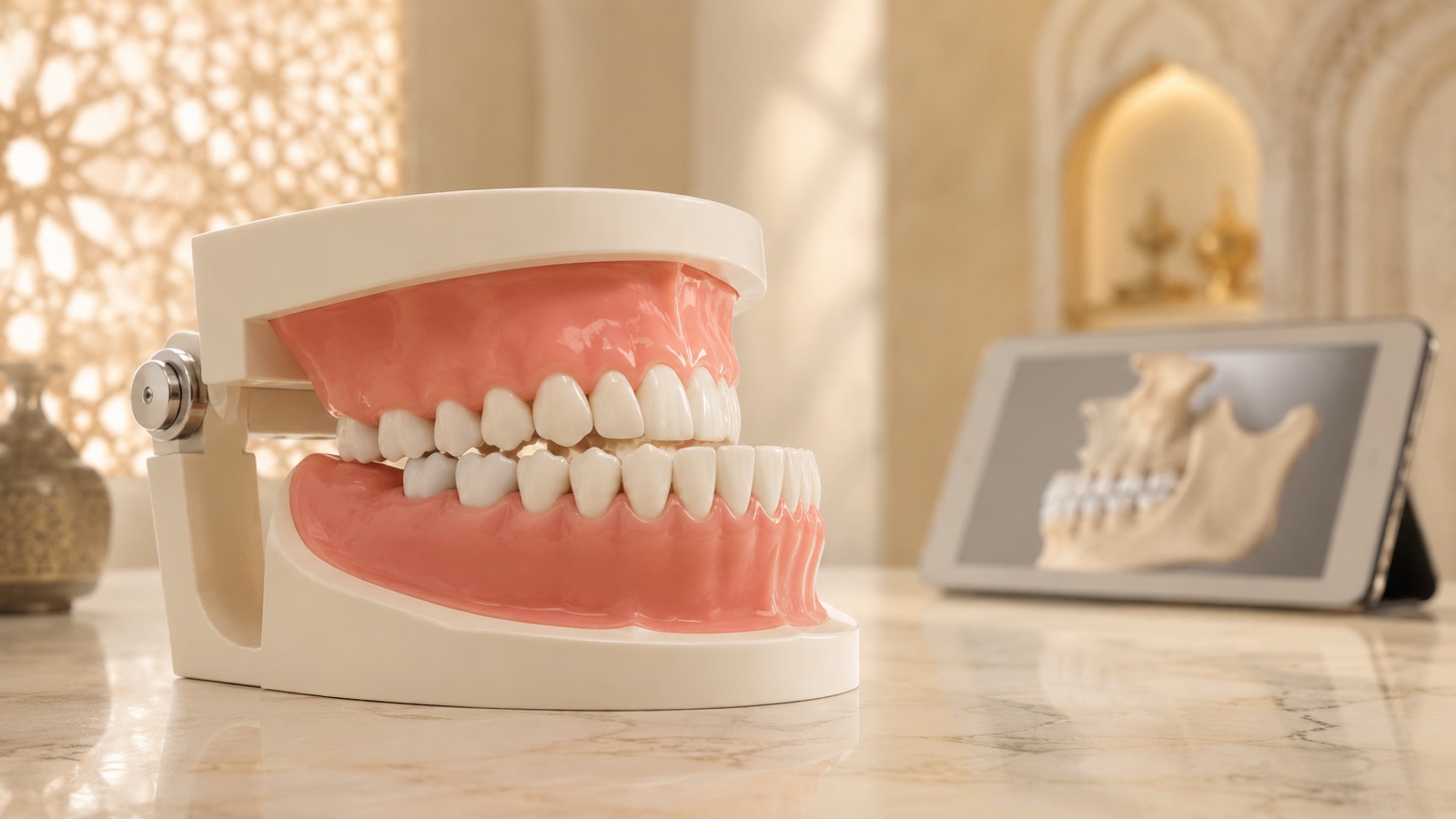
Class III malocclusion — sometimes called an underbite or a protruding lower jaw — is one of the more significant conditions in orthodontics and jaw growth. It isn't only about how the teeth look; it can also affect the shape of the face, the way you chew, and how the jaws meet when the mouth is closed.
In some cases the cause is a lower jaw that sits too far forward. In others, it's an upper jaw that has grown too far back. Sometimes both factors combine to different degrees — which is why diagnosis needs a careful examination by an orthodontist.
What does Class III malocclusion mean?
In a normal bite, the upper teeth sit slightly ahead of the lower teeth when the mouth closes. In Class III malocclusion, the lower teeth may sit in front of the upper teeth, or the lower jaw may look more prominent than normal.
This can be mild — noticeable only when the teeth are closed together — or more severe, to the point that it affects the appearance of the face and the side profile.
What causes Class III malocclusion?
Causes vary from person to person, but genetics play a major role in many cases. If a family member has a protruding lower jaw or an underbite, the chances of a child developing the condition may be higher.
Other possible causes include:
- A growth mismatch between the upper and lower jaws.
- Underdevelopment of the upper jaw relative to the lower jaw.
- Excessive forward growth of the lower jaw.
- Certain oral habits in childhood.
- Tooth-alignment problems that lead to a front or side crossbite.
So it isn't enough to look at the teeth alone — the relationship between the jaws, the shape of the face, the overall dentition, and the direction of growth all need to be assessed.
Signs that may point to Class III
Patients or parents may notice some clear signs, such as:
1. Lower teeth sitting in front of the upper teeth
This is one of the most important signs. It shows when the mouth closes, with the lower teeth coming forward over the upper teeth instead of sitting behind them.
2. A prominent chin or changed side profile
In some cases the chin looks pushed forward, which can give the face a forward-projecting appearance that may look unbalanced in profile.
3. Difficulty biting or chewing
The patient may feel that the teeth don't meet comfortably, or that chewing happens only on certain areas of the teeth.
4. An effect on the smile and confidence
Because the condition can affect the shape of the face and the smile, some patients feel self-conscious about their appearance — especially in photos or while talking.
Why does early diagnosis matter?
Early diagnosis matters because, in children, the jaw bones are still growing and can still be guided. This gives the doctor a window to steer the direction of growth and adjust the path of the jaws before puberty is complete.
The earlier the condition is found, the more likely it is that simpler treatment options can be used, and the less likely that more complex intervention will be needed later. That said, every case is different, and the right plan can only be set after a clinical exam and the necessary diagnostic imaging.
How Class III malocclusion is treated
Treatment depends on the patient's age, the severity of the case, and the source of the problem: is it in the teeth only, in the jaw bones, or in both?
First: early treatment for children
In childhood, the growth phase can be used to guide the relationship between the jaws. In some cases the doctor uses special appliances that help stimulate growth of the upper jaw or adjust the relationship between the jaws.
This kind of treatment doesn't always mean the problem is fully resolved, but it can reduce the severity of the case and help improve the path of growth — making future treatment easier and more stable.
Second: compensatory orthodontic treatment for adults
In mild to moderate cases in adults, surgery may not be needed. Orthodontics can be used to move the teeth in a way that compensates for the existing jaw-relationship discrepancy.
This option is called compensatory treatment because it doesn't significantly change the jaw bones; instead, it improves the relationship of the teeth and the bite as much as possible within the limits of the case.
It usually suits cases where the facial appearance is acceptable and the problem isn't severe at the skeletal level.
Third: surgical orthodontic treatment
In severe cases — especially in adults after growth is complete — orthodontics alone may not be enough to reach a satisfactory functional and aesthetic result.
Here the patient may need a combined plan between the orthodontist and the maxillofacial surgeon. Treatment usually begins with an orthodontic phase to prepare the teeth, then surgery is performed to reposition the jaw or jaws, after which the orthodontic phase is completed to reach the final bite.
This option is typically used when the skeletal discrepancy is clear and affects the shape of the face and chewing function.
Do all Class III cases need surgery?
No. Not every case needs surgery. Some cases are mild and can be treated with orthodontics alone, and some cases in children can be improved with early treatment — while severe or advanced cases need surgical intervention after growth is complete.
The decision depends on several factors, including:
- The patient's age.
- The severity of the jaw protrusion or crossbite.
- The condition's effect on the shape of the face.
- The state of the teeth and gums.
- The patient's expectations from treatment.
- The results of orthodontic imaging and analysis.
When should you see an orthodontist?
It's best to see an orthodontist when you notice any crossbite, a clearly protruding lower jaw, or teeth that don't meet properly when closed. Children should also be checked early if there's a family history of jaw problems or a prominent chin.
An early check doesn't necessarily mean treatment starts right away — but it helps determine the right time to intervene if needed.
In summary
Class III malocclusion isn't just a problem with how the teeth are arranged; it can be tied to jaw growth, facial balance, and chewing function. So it may need a careful diagnosis and a treatment plan suited to the patient's age and the severity of the case.
Treatment may be early — to guide jaw growth in children — or compensatory orthodontics in moderate cases, or surgical orthodontics in severe cases in adults.
The clearer and earlier the diagnosis, the better and more precise the treatment options.
If you notice an underbite or a forward lower jaw, seeing an orthodontist is the first step toward the right treatment and a more balanced smile.
Written by
Dr. Abdulnasser Mosa Almahmoud
Board-certified orthodontist with 25+ years of experience treating adults and children in Riyadh.
AboutReady to start your smile journey?
Book a consultation with Dr. Almahmoud to find the treatment that fits your case.